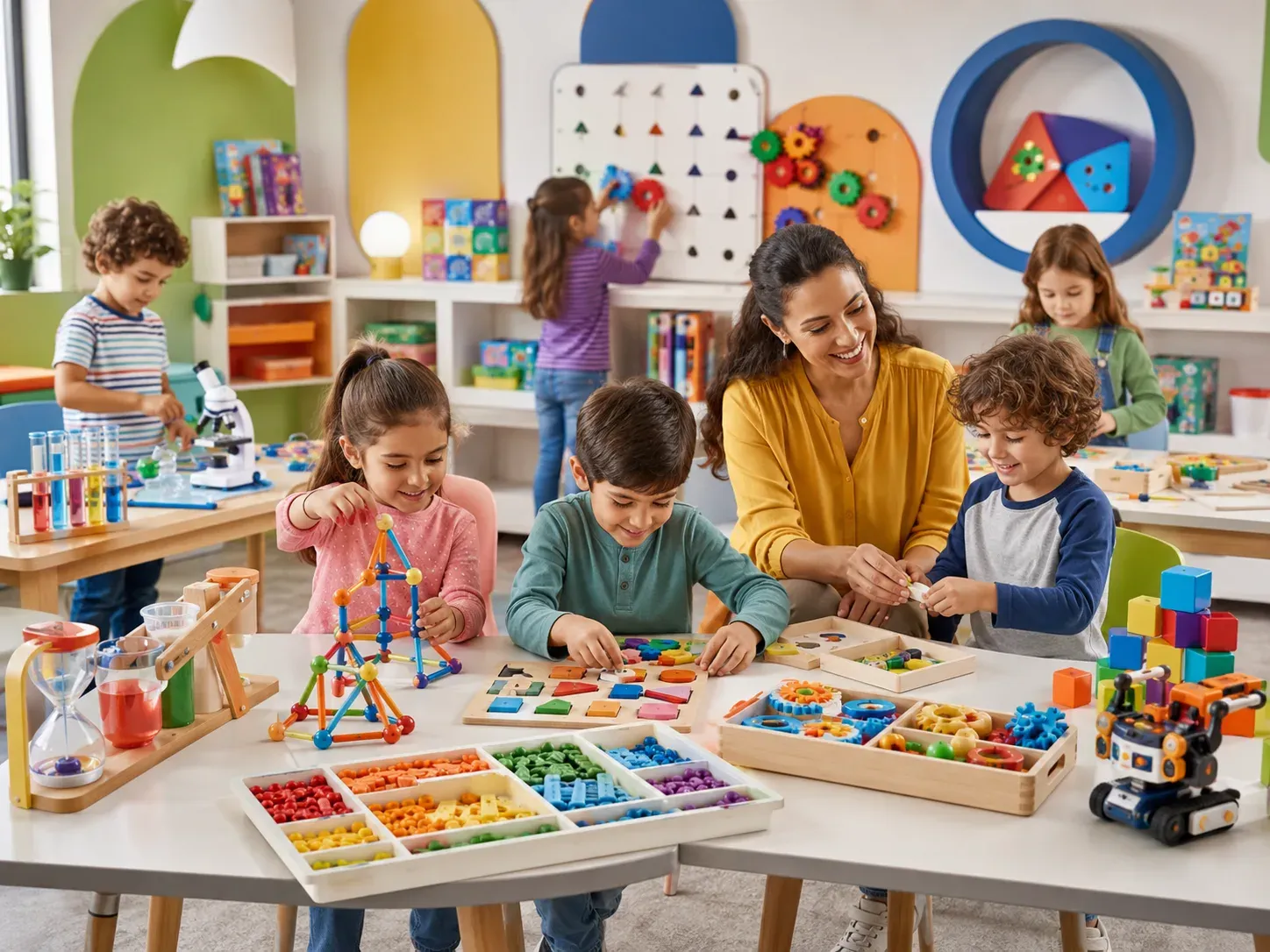
Choosing a toy for one child at home is already a thoughtful decision. Choosing toys for a classroom, preschool, daycare, library corner, therapy room, or shared learning space adds another layer entirely.
A toy in a school setting may be used by several children in a single morning. It may move from a shelf to a table, then to the floor, then into a group activity before being sorted back into storage. Different children will approach it with different levels of confidence, different interests, and different ways of playing. Teachers also need to be able to introduce it quickly, adapt it to a lesson, clean it without complicated steps, and put it away before the next part of the day begins.
That is why educational toy selection for schools is less about finding the most impressive product and more about asking whether a toy can live well inside the rhythm of a learning environment.
The strongest classroom toys are often simple at first glance. They are sturdy enough for repeated use, open enough to support more than one idea, and clear enough that children can begin exploring without a long explanation.

Start with the reality of the learning space
Before comparing materials, colors, or learning claims, it helps to look at how the room actually works.
A small preschool classroom with low shelves has different needs from a large multipurpose room. A reading corner may benefit from quiet storytelling materials, while an active learning area needs toys that can tolerate movement and frequent handling. A toy that works beautifully for a group of four may become frustrating in a class of twenty if there are not enough pieces to share.
This sounds obvious, but it is easy to shop for the toy first and think about the environment later.
A more useful starting point is to ask where the toy will be used, how many children are likely to use it at once, how often it will come out, and who will be responsible for setting it up and putting it away. These questions quickly reveal whether a product truly fits the room or simply looks appealing in isolation.
Prioritize safety that can withstand repeated use
Safety in schools is not only about whether a toy is suitable on the first day. It also matters how that toy holds up after weeks and months of being carried, stacked, dropped, cleaned, and shared.
Smooth surfaces, sturdy construction, age-appropriate sizing, and secure components all matter more when a material is used by many hands. Teachers should also be able to inspect a toy easily. If a piece loosens, a surface chips, or a component begins to wear, the problem should be visible rather than hidden inside a complicated construction.
Clear material information is useful too. Schools often need to communicate confidently with families and staff about what children are using. Products that are straightforward about their materials, intended age range, care instructions, and use limitations are easier to integrate into a professional learning environment.
The goal is not to create a room where nothing ever gets scratched. Classroom materials are meant to be used. The goal is to choose toys that remain dependable even when they are used enthusiastically.
Think about how several children will use the toy together
Some toys are designed around a single child completing a single task. That can still have a place in a classroom, especially for focused or quiet work, but shared spaces also benefit from materials that naturally allow more than one child to participate.
Blocks are a simple example. One child can build independently, two children can negotiate how to connect their structures, and a larger group can turn the same set into a town, road system, animal habitat, or imaginary world. The toy does not dictate how many children must participate.
Group-friendly toys can create opportunities for children to negotiate space, exchange ideas, take turns, copy one another, solve disagreements, and continue a shared story. Those interactions are often just as meaningful as the object being built or the puzzle being completed.
Quantity matters here as much as design. A good classroom set should contain enough pieces for the intended group. Too few pieces can turn a promising activity into a long exercise in waiting, while an enormous set can become difficult to manage. The right amount depends on the age group, room size, and how teachers plan to introduce the material.
Look for toys that children can understand without constant adult direction
Teachers already manage transitions, conversations, routines, observation, documentation, and many different needs at the same time. A classroom toy should not require an adult to stand beside it continuously just to keep the activity functioning.
That does not mean the teacher has no role. A thoughtful prompt can completely change the direction of play. The difference is that the material itself should remain usable after the prompt is given.
For example, a teacher might ask children to build something taller than their hands, create a bridge that can hold three figures, sort objects by a rule they invent, or use loose pieces to tell a story. After that, the children should have room to take over.
Materials that support this kind of independence tend to fit naturally into learning spaces because they allow teachers to move between observing, asking questions, helping another group, and returning later to see how the play has developed.
Choose flexibility over a single narrow outcome
Educational toys are often marketed around one skill: counting, color recognition, fine motor control, problem solving, or language development. Those goals can be useful, but classroom materials become more valuable when they are not trapped inside one exercise.
A set of counters can be used for sorting today, simple number stories tomorrow, pattern-making later in the week, and pretend shop play after that. Construction pieces can support spatial reasoning during one activity and collaborative storytelling during another. Figurines may become part of a language lesson, a dramatic-play scene, or a conversation about communities and environments.
This flexibility matters because teachers rarely need more objects that can only do one thing. They need materials they can reinterpret as the children, curriculum, and classroom questions change.
Open-ended does not mean directionless. It simply means the toy leaves enough room for teachers and children to decide what the next challenge should be.
Match the challenge to the children, not just the label on the box
Age recommendations are a useful starting point, but classrooms often contain a wider range of abilities than a single age label suggests.
Two children of the same age may approach the same puzzle very differently. One may want a complex challenge immediately, while another may still be building confidence with simpler forms. A mixed-age learning space adds even more variation.
For that reason, toys that allow different levels of participation are especially useful. A younger child may stack three pieces while an older child uses the same material to build a symmetrical structure. One child may sort objects by color while another invents categories based on size, function, or pattern.
When a toy can scale in this way, teachers do not have to replace the entire activity every time the group needs a new level of challenge. They can change the question, the number of pieces, the time available, or the way children work together.
Make storage part of the selection process
A toy does not stop being a classroom object when playtime ends. It still needs somewhere to go.
Storage is one of the easiest details to overlook during purchasing, and one of the most noticeable once a toy enters daily use. Sets with dozens of tiny pieces may be wonderful during play but frustrating if there is no clear way to sort them afterward. Bulky items may work well in a large room but create constant clutter in a smaller one.
Before purchasing, imagine the full cycle: children take the toy out, use it, move it around, clean up, and return it to its place.
Clear categories help. A tray, basket, shallow bin, or compartment that makes the contents visible can support children in returning materials independently. When children know where pieces belong, clean-up becomes part of the room’s routine rather than a task that always falls back on the teacher.
Storage also affects whether toys are actually used. Materials buried in deep, crowded containers are easy to forget. Toys that can be seen and reached tend to invite more spontaneous interaction.
Consider cleaning before the first spill happens
Shared learning materials inevitably meet sticky fingers, classroom floors, outdoor dust, art supplies, and the occasional snack crumb. Cleaning is not an exceptional event; it is part of normal use.
A toy that requires a complicated care routine may be difficult to maintain in a busy classroom, even if it looks excellent when new. Materials with accessible surfaces and straightforward care instructions are easier to keep in regular rotation.
It is also worth considering how many seams, hidden cavities, fabric layers, or tiny components need attention. The best choice is not always the toy that can be cleaned most aggressively. It is the one whose care requirements make sense for the setting and the material.
When care is simple, teachers are more likely to maintain the toy consistently instead of postponing cleaning until it becomes a larger task.
Treat durability as part of learning quality
Durability is often discussed as a budget issue: schools want purchases to last because replacing materials costs money. That is true, but durability also shapes the quality of play itself.
Children notice when pieces no longer connect properly, a wheel repeatedly falls off, or a puzzle no longer lies flat. A material that works inconsistently asks children to spend attention on the toy’s failure instead of the idea they were exploring.
Reliable construction supports repetition. Children can return to the same material over time, refine what they did before, and discover new ways to use something already familiar.
That repeated relationship can be especially valuable in early childhood classrooms, where learning often grows through revisiting rather than completing an activity once and moving on forever.
Durability therefore deserves to be considered alongside educational potential, not after it.
Include different ways of participating
Not every child enters play in the same way. Some children jump into a group immediately. Others prefer to watch first. Some enjoy precise tasks, while others want to move pieces around, tell stories, or build at a larger scale.
A well-balanced learning space gives children multiple entry points.
This does not mean every single toy must serve every child. It means the overall selection should avoid depending on only one kind of participation. If every activity requires fast verbal interaction, some children may have fewer comfortable ways to engage. If everything is highly structured, children who enjoy experimentation may lose interest quickly.
When reviewing school toys, it helps to ask whether a child can use the material alone, beside another child, and as part of a group. Can the toy support both a simple first attempt and a more complex idea later? Can children use it without needing to produce one correct-looking result?
Those questions often reveal more about inclusivity than a long list of learning claims on the packaging.
Give teachers room to extend the play
Good classroom materials do not compete with teaching. They give teachers something to work with.
A versatile toy can become the starting point for questions, vocabulary, stories, measurement, comparison, collaboration, observation, or reflection. A teacher might introduce a material with one purpose and discover that the children take it somewhere completely different.
That flexibility is useful because real classrooms are responsive. Plans change when children become fascinated by a topic, when a group needs more time, or when one unexpected question opens a better direction than the original lesson.
A toy with only one prescribed use can be difficult to adapt in those moments. A flexible material can follow the class.
Look beyond the lowest purchase price
Budget matters in every school, but the cheapest option is not always the most economical once daily use is considered.
A better comparison looks at how often the toy can be used, how many children it can serve, how many kinds of activities it supports, how easy it is to maintain, and how well it holds up over time.
A slightly more expensive set that can be used across several age groups and learning areas may offer more practical value than a cheaper product that is only useful for one short activity. The opposite can also be true: a simple, affordable material may outperform a complicated premium toy if children keep finding new ways to use it.
Value comes from fit, not from price alone.
For schools purchasing at scale, consistency matters as well. It is helpful to know whether replacement pieces are available, whether sets can be expanded later, and whether additional classrooms can use the same system without introducing an entirely new storage or maintenance routine.
Observe what happens after the toy enters the room
The purchasing decision does not have to be the final judgment.
Once a toy is in use, teachers can learn a great deal by watching what actually happens. Do children return to it without being prompted? Does it support longer play or only a brief first impression? Do several children use it successfully together? Is clean-up manageable? Are important pieces constantly getting lost? Does the material still work once the novelty wears off?
These observations are useful for future purchasing because they turn general preferences into evidence from the school’s own environment.
Over time, a learning space develops its own pattern. Teachers begin to recognize which materials earn a permanent place on the shelf, which are better used occasionally, and which looked promising but never quite fit the room. Read our companion checklist on 10 things to check before choosing educational toys, see how durable toys simplify shared play, and explore open-ended building blocks for group spatial activities.
Featured Serious Fun Solutions for Learning Spaces
Equip classrooms and group play areas with durable, high-impact educational toys:
- Creative Building Blocks: 50 precision-cut solid wood blocks in 10 architectural shapes, ideal for peer collaboration.
- Engineering Building Set: Hands-on engineering set featuring jumbo nuts, bolts, and wooden beams for 3D spatial thinking.
- Science Discovery Lab Kit: Safe home/school chemistry and physics kit with shatterproof acrylic tubes for STEM discovery.
The best school toys fit the whole day, not just one activity
Choosing toys for schools and learning spaces means looking beyond the moment when a child first opens the box.
The strongest choices make sense before, during, and after play. They are clear enough for children to approach, flexible enough for teachers to extend, durable enough for repeated use, and manageable enough to clean and store as part of a real classroom routine.
Most importantly, they leave room for children to bring something of their own to the experience.
A good educational toy does not need to deliver every lesson by itself. In a thoughtful learning space, its job is simpler and more useful: to give children a reliable material they can explore, revisit, share, question, combine, and gradually understand in new ways.
