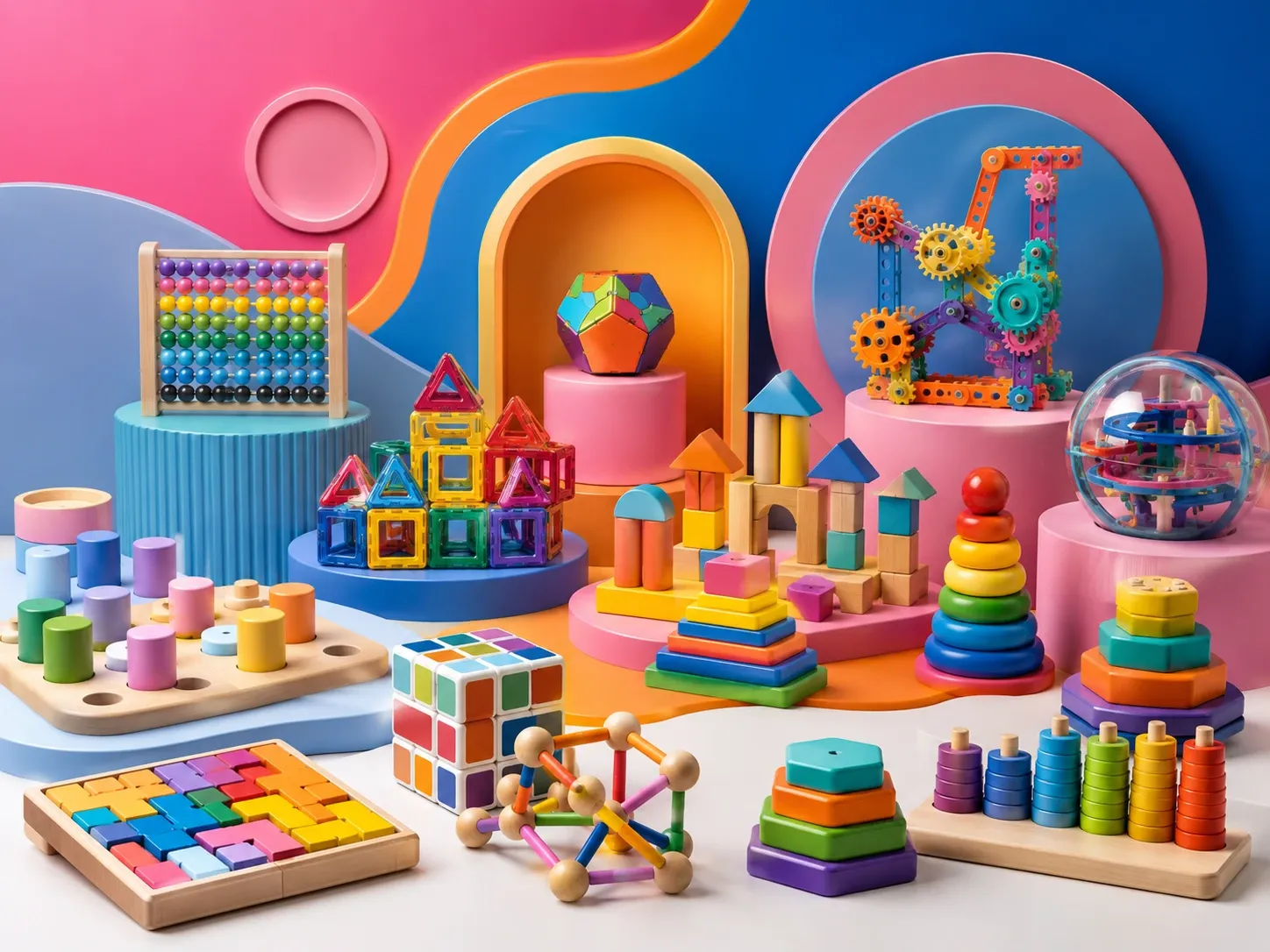
Children do not always need more toys in front of them to play for longer. In many homes, the opposite can happen. A shelf packed with puzzles, vehicles, dolls, blocks, art materials, musical toys, and half-finished sets may offer plenty of options, yet make it harder for any one idea to stand out.
That is where toy rotation can help.
At its best, toy rotation is not a strict system for controlling what a child is allowed to use. It is simply a way of changing what is visible and accessible so the play space feels easier to understand. Some toys stay out, others rest for a while, and the selection changes as children’s interests change.
The important part is the reason behind it. The goal is not to create a perfectly minimal shelf or to make old toys feel artificially new every few days. It is to give children enough choice to follow their ideas without surrounding them with so much visual and physical clutter that play becomes harder to begin.

Think of rotation as editing the environment
Toy rotation works best when it is treated as a form of play space organization rather than a schedule.
Parents do not need to count every item, create a complicated inventory, or replace the entire shelf on a fixed day. A useful rotation can be as simple as moving a few rarely used toys into storage and leaving more breathing room around the things a child is currently exploring.
That breathing room matters.
When children can see where blocks belong, notice the puzzle on a low shelf, or reach a basket of pretend-play objects without moving five other containers first, starting to play requires less effort. The environment gives a clearer invitation.
This does not mean every room needs to look sparse. A lively family home can still support focused play. The aim is simply to make the available choices readable.
Start by watching before changing anything
It is tempting to begin toy rotation by clearing shelves immediately. A better first step is to observe.
For a few days, notice which toys children actually reach for. Watch what they carry from room to room, what becomes part of repeated stories, and what gets ignored even when it is placed in an obvious spot.
Also pay attention to how a toy is being used.
A set of wooden blocks may look like one toy, but a child might use it to build roads, create animal homes, balance objects, make pretend food, or mark out spaces on the floor. That kind of flexible use is easy to miss if the only question is, “Did they play with the blocks today?”
Likewise, a toy that appears untouched may still be part of a longer play idea. A basket of animals might sit beside a block structure for two days because the child is returning to the same imaginary world.
Observation keeps rotation from becoming arbitrary. Instead of deciding what should be interesting, adults respond to what is already happening.
Build a visible selection with different kinds of play
There is no universal number of toys that should be available at once. The right amount depends on the child’s age, the size of the space, the type of toys, and how the family uses the room.
Rather than aiming for a specific number, think about variety.
A visible selection might offer opportunities for:
- building or constructing,
- pretend play,
- movement,
- drawing or making,
- sorting and problem solving,
- sensory exploration,
- books or quiet observation.
These categories do not require separate products. One open-ended material can cover several of them. Blocks, for example, can become a construction material, a sorting activity, a storytelling prop, or part of a simple counting game.
This is why a smaller shelf does not necessarily mean a smaller play experience. What matters is how much possibility the available materials hold.
A balanced setup might include a block set, one puzzle, a basket of figures, paper and drawing tools, and a few pretend-play objects. In another home, it may look completely different.
The point is not to copy a shelf arrangement. It is to make sure the visible toys do not all ask the child to do the same thing.
Keep genuine favorites available
One of the easiest ways to make toy rotation feel restrictive is to remove a toy simply because it has been available for “too long.”
Children often return to the same object for good reasons. A favorite vehicle may be part of every pretend game. A stuffed animal may travel from the playroom to the bedroom. A familiar puzzle may be something a child enjoys doing independently because they already understand it.
Repeated use is not a problem to solve.
In fact, familiarity can give children a stable starting point for more complex play. Once they no longer have to figure out what an object does, they can focus on what else they might do with it.
So if a toy is still actively used, there is no need to rotate it out just to follow a system.
Some families find it helpful to think of the shelf in two layers: a few “always available” favorites and a smaller group of items that change more often. That keeps the environment fresh without making it unpredictable.
Do not rotate away a play idea that is still growing
Adults and children often experience time differently in play.
To an adult, a set of blocks may have been on the floor for three days. To the child, it may still be the same airport, zoo, city, or house they are gradually expanding.
When a child returns to a project repeatedly, clearing it away too soon can interrupt more than the physical setup. It can remove the memory cues that help them pick up an idea where they left off.
This is especially noticeable with construction play, small-world play, train tracks, craft projects, and elaborate pretend scenes.
If space allows, create a small “save spot” for unfinished play. It might be one tray, one corner of a shelf, a low table, or a section of the floor that does not need to be reset at the end of every day.
A saved project gives children permission to continue rather than constantly begin again.
Toy rotation should create room for deeper play, not compete with it.
Rotate by interest, not by the calendar alone
A weekly rotation sounds simple because it is easy to remember. But children’s interests rarely run on seven-day cycles.
One week a child may be fascinated by arranging objects in rows. The next, they may build with the same set every day. A pretend restaurant might last for an afternoon or quietly reappear for a month.
A calendar can still be useful as a reminder to look at the play space, but it does not need to decide what gets removed.
Instead, use interest as the main signal.
If children are still using a toy in varied ways, keep it available. If a shelf has become background scenery and most items have not been touched for a while, that may be a good time to change a few things.
This keeps rotation responsive instead of mechanical.
Learn the difference between boredom and mastery
A toy being used quickly does not always mean the child is bored with it.
Sometimes children repeat an activity because they are becoming more competent. They may complete the same puzzle faster, rebuild a familiar tower, sort the same objects, or replay the same story with only small changes.
From the outside, repetition can look like a lack of new ideas. From the child’s perspective, they may be testing consistency, speed, control, memory, or a new variation on something they already understand.
Before rotating an item out, ask a more useful question: Is the play still changing?
If the answer is yes, the toy may still have plenty of life in the current cycle.
If the child picks it up, immediately abandons it, and rarely includes it in other play, then a break may be useful.
Look for practical signs that a rotation would help
You do not need a formal tracking system. Everyday behavior usually gives enough information.
A rotation may be useful when:
- children repeatedly dump containers without settling into play,
- most of the shelf is ignored,
- favorite materials are difficult to reach because other toys are in the way,
- pieces from many sets are constantly mixed without serving the play,
- clean-up takes longer than the actual activity,
- children seem to move rapidly from one option to another without developing an idea.
None of these signs means there are “too many toys” in a moral sense. They simply suggest that the current arrangement may not be helping the child see what is available.
Sometimes the solution is a full rotation. Often, it is smaller: remove two baskets, combine related materials, move one item to a better height, or give a large toy more floor space.
Reintroduce toys without turning it into a performance
When a toy returns after being stored, there is no need to announce it as if it were a brand-new purchase.
A quiet reintroduction is often enough.
Place the toy somewhere visible, make sure all the important pieces are present, and let the child notice it in their own time.
You can also create a small invitation by pairing materials that naturally work together. Put wooden blocks near a few animal figures. Place play food beside bowls and a cloth. Set a puzzle on a tray instead of stacking it under three others.
These arrangements offer a starting point without prescribing what the child should do.
An invitation is different from an instruction. “I wonder what you could build for these animals” leaves room for the child to reject the idea and invent something else.
That sense of ownership matters if the purpose of rotation is to support independent play.
Let children have a say in what stays
Toy rotation does not have to be something adults do secretly after bedtime.
As children get older, involving them can make the system feel more respectful and practical.
You might ask which toys they definitely want to keep available, which ones they are finished with for now, or what kind of play they want more room for.
Young children may not make consistent choices, and that is fine. The goal is not to hand over every storage decision. It is to recognize that the play space belongs to them too.
Even a simple choice can help: “Do you want the train set or the animal basket on this shelf this week?”
This can also reveal interests that adults have missed. A toy that seems forgotten may be important to a story the child is planning to continue later.
Keep stored toys genuinely accessible to the family
“Out of rotation” should not mean “lost somewhere in the house.”
If possible, store toys in a way that adults can retrieve them without a major search. Grouping by broad type is usually more useful than creating a highly detailed system that is difficult to maintain.
Clear bins, simple labels, or consistent shelf zones can work well. For families with older children, picture or word labels can also make the storage system easier to understand.
Try not to pack containers so tightly that taking out one toy requires unpacking an entire cupboard.
The easier the storage is to use, the more flexible rotation becomes. If a child suddenly asks for a familiar set, retrieving it does not feel like breaking the system.
That is an important mindset shift: rotation is a tool for the family, not a rule the family has to obey.
Small homes may benefit most from smaller rotations
Toy rotation is often shown in spacious playrooms with low shelves and dedicated storage. In reality, many children play in shared bedrooms, living rooms, dining areas, or small apartments.
In those spaces, rotation can be even more practical because floor and shelf space have to do several jobs.
A small basket of building materials may live beside the sofa. Art supplies may stay in a cupboard and come out when needed. Larger toys may rotate according to how much floor space the family needs that week.
The goal is not to create a separate playroom where none exists. It is to reduce friction between play and the rest of family life.
A system that makes it easier to clear the dining table, find missing pieces, and restore the room after play can support both children and adults.
Rotation can look different for siblings
Shared play spaces add another layer because one child’s current interest may be another child’s forgotten toy.
With siblings, it usually helps to avoid treating the entire room as one rotation.
Some materials can be shared, while each child keeps a few personal favorites or age-appropriate items consistently available. Toys with small parts may also need separate storage if a younger sibling uses the same space.
It is also worth watching how children use each other’s materials. An older child’s blocks may become part of a younger child’s pretend kitchen. A younger child’s animal figures may suddenly become characters in an older child’s construction project.
Those crossovers are not a problem. They are one reason rigid categories often fail in real play.
The rotation should make shared materials easier to use, not enforce ownership boundaries that the children themselves do not need.
Do not use rotation to chase constant novelty
One risk of rotating too often is that the system starts to depend on surprise.
If every shelf change is designed to produce an immediate “wow,” adults can feel pressure to keep making the environment new. That can quietly turn toy rotation into another form of entertainment management.
Children do not need every play session to begin with novelty.
Familiarity supports its own kind of creativity. The same blocks can be used differently because the child’s ideas have changed. The same dolls can enter a new story because something happened at school. The same puzzle may become satisfying for a new reason once it is easier to complete.
Rotation is useful because absence can make an object easier to notice again, but “newness” should not be the main goal.
The deeper goal is renewed attention.
Let clean-up inform the rotation
Clean-up problems often reveal more about a play space than the shelf does.
If a child cannot tell where anything belongs, there may be too many categories. If every container is overflowing, the visible selection may be too large. If one toy takes up half the room but is rarely used, it may be better stored elsewhere.
At the same time, avoid designing a system that is so neat that children cannot maintain it.
A basket labeled “animals” is often easier than separating farm animals, sea animals, dinosaurs, and pets into different containers. A tray for a puzzle can be more practical than a complicated box arrangement.
The easier it is for children to participate in resetting the space, the more sustainable the rotation becomes.
A calm play space is not one that always looks untouched. It is one that can move from play to rest and back again without creating constant frustration.
There are times when no rotation is needed
Toy rotation is optional.
If a child plays deeply, the room is manageable, and the family is comfortable with the current setup, there is no reason to change it because rotation is popular.
Likewise, some periods of childhood naturally involve intense attachment to a small group of toys. Other periods are more expansive, with children combining many materials at once.
Both can be healthy parts of play.
The best system is the one that supports what the child is doing now while remaining manageable for the household.
That may mean rotating every few weeks, changing one basket at a time, keeping most toys available, or not using a formal rotation at all.
A simple rhythm is usually enough
For families who want a starting point, keep it light.
Begin by leaving favorite toys where they are. Remove a few items that have been ignored. Make sure the remaining shelf includes different kinds of play. Store the removed toys somewhere easy to retrieve.
Then wait.
Watch what changes. Does the child settle into play more quickly? Do they combine materials in new ways? Is clean-up simpler? Are they asking for something that was removed?
Use those observations for the next small adjustment.
Over time, the rhythm becomes less about “doing toy rotation correctly” and more about noticing how the environment affects play. Combine rotation strategies with our guide on building a calm play corner at home, the value of open-ended play for imagination, and self-directed focus with Montessori busy boards.
Recommended Serious Fun Products
Support toy rotation with versatile, compact Serious Fun products:
- Animal Puzzle Blocks: 16 wooden cubes forming 6 animal illustrations, perfect for periodic toy rotation cycles.
- Sensory Activity Cube: Compact 5-sided multi-sensory cube that saves shelf space while offering diverse play.
Conclusion
Toy rotation works best when children barely experience it as a restriction.
A thoughtful rotation gives familiar toys room to be seen again, protects ongoing interests, reduces unnecessary clutter, and makes the play space easier to navigate. It can support children’s focus without demanding that every shelf look minimal or every week begin with a completely new setup.
Keep favorites available. Leave unfinished ideas alone when they are still growing. Rotate according to interest more than the calendar, and let children influence the choices when they are ready.
The purpose is not to control play. It is to create enough space around it that children can see an idea, choose it, and stay with it for as long as it matters.
