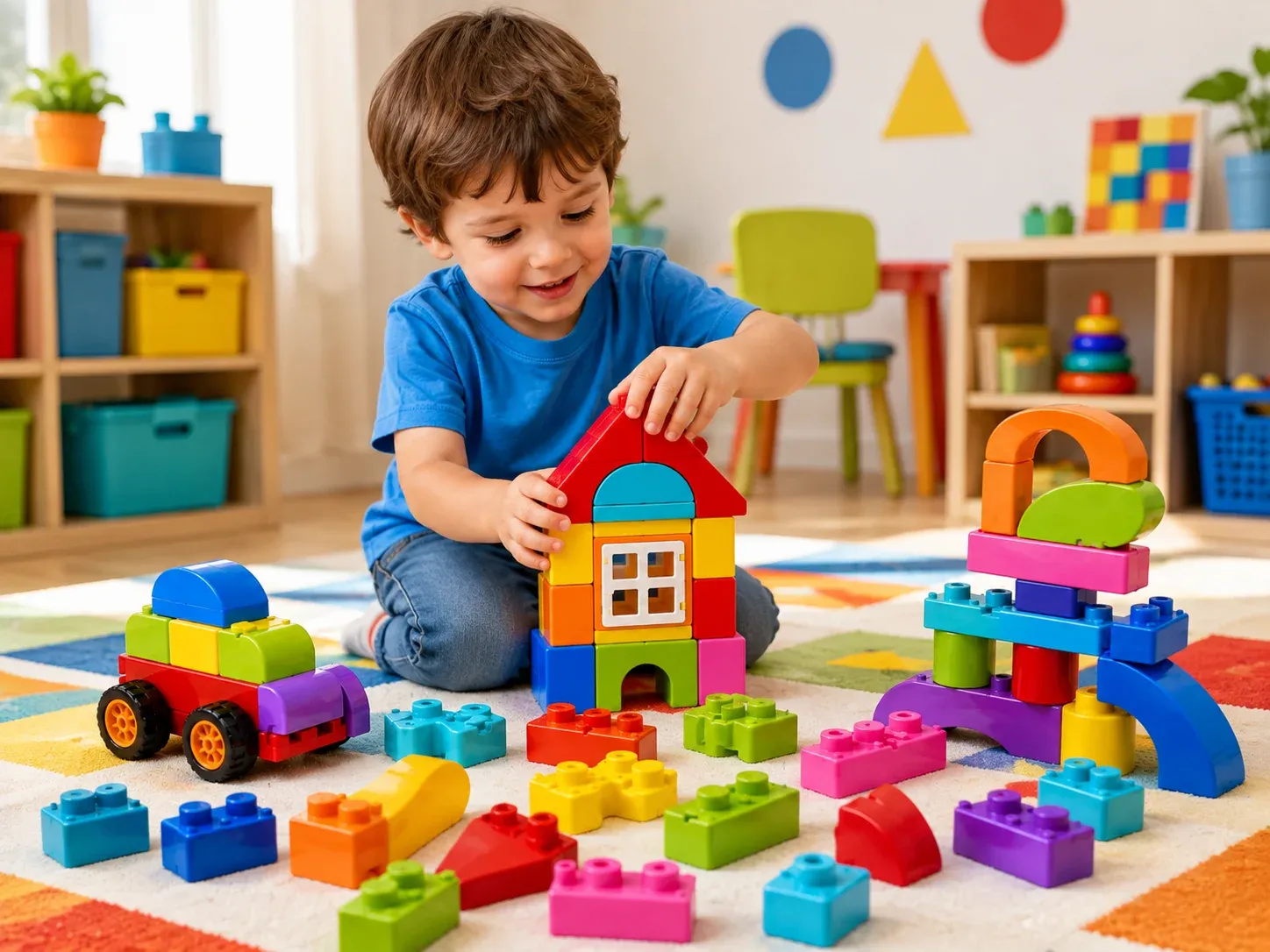
A set of building blocks can look almost too simple.
There are no instructions to follow, no buttons to press, no voice prompts, and no single finished model that proves the activity is complete.
A child picks up one shape and decides what to do with it.
That decision is where much of the value begins.
One rectangular block may become the base of a tower. A few minutes later, the same piece is a bridge. Tomorrow it may be a bed for a toy animal, a wall around a pretend farm, a road divider, a loaf of bread in a play kitchen, or something with no obvious real-world name at all.
As children move blocks around, they are constantly dealing with practical questions about space.
Will this piece fit?
Is this one long enough?
What happens if I turn it?
Why does this side keep falling?
How can I make both ends of the bridge the same height?
Children may not use words such as geometry, proportion, balance, or spatial planning. They do not need to. The concepts are present in the physical problem in front of them.
Open-ended block play gives children a concrete way to explore those relationships before they ever need to describe them formally.
Spatial reasoning begins with moving real objects
Spatial reasoning is often discussed as if it were a purely mental skill.
In early childhood, much of it begins with the body and the hands.
A child sees an empty gap between two block towers and tries to fill it.
The first piece is too long.
They rotate it.
Still too wide.
They choose a shorter block.
This small sequence asks the child to compare size, position, orientation, and available space.
The feedback is immediate.
The block either fits or it does not.
With repeated play, children begin making more of these judgments before placing a piece. They look at the opening, scan the available blocks, turn one in their hand, and then test it.
That pause before action is a simple form of planning.
Rotation changes what a shape can do
One of the most useful things children discover through block play is that the same object behaves differently depending on its orientation.
A rectangular block standing vertically is tall and narrow.
The same block placed flat becomes low and wide.
Turn it again and it may become a beam connecting two structures.
Adults understand this automatically because we have years of experience with physical objects.
Children build that understanding through repetition.
They rotate, flip, stand, stack, and compare.
A piece that seemed “wrong” for one purpose may become exactly right after being turned.
This kind of mental and physical rotation is one reason blocks remain interesting beyond the stage of simple stacking.
The child is not only asking, “Which block should I use?”
They are also learning to ask, “How else could this block be positioned?”
Towers are simple experiments in stability
Tower building is one of the earliest block activities, but it can remain surprisingly rich.
At first, a child may simply place one block on top of another.
Then the tower falls.
Eventually, patterns begin to emerge.
Wider pieces often feel more stable at the bottom.
Pieces placed far off-center are more likely to shift.
Tall, narrow structures behave differently from low, broad ones.
Some shapes stack easily on one face and wobble on another.
Children do not need an adult to explain all of this.
The structure provides its own feedback.
If the tower stays up, the current arrangement works for now.
If it falls, the child has new information.
A collapse is not the opposite of successful play
Adults often feel the urge to save a leaning tower.
A hand reaches out automatically.
But if the situation is safe, letting the structure fall can be useful.
The collapse shows what the arrangement could not support.
Some children laugh and rebuild immediately.
Others study the pieces on the floor.
They may widen the base, switch the order, use fewer levels, or repeat the same design to see whether the result changes.
The important thing is not to turn every collapse into a lesson.
A child does not always need to hear, “See, the base was too narrow.”
Sometimes a quiet pause is enough.
If they want help, simple questions can support observation:
“Which part moved first?”
“Do you want to try a wider piece underneath?”
“What could make this side steadier?”
The block structure can remain the main source of information.
Balance becomes something children can feel
Balance is easier to understand through objects than through explanation.
Place a long block too far beyond the edge of a tower and the whole arrangement may tip.
Move it inward and the structure becomes steadier.
Put a beam across two supports and children quickly notice that the placement of those supports matters.
The physical experience is memorable because the child can see the consequence of a small adjustment.
Different shapes add different possibilities.
A cube has several stable faces.
A cylinder may roll.
An arch creates open space underneath.
A triangular block can work as a roof but may be awkward as a base.
These properties become part of the child’s working knowledge.
They do not have to memorize a list of geometric facts.
They learn what shapes do by using them.
Empty space is part of the design too
Block play is not only about the blocks themselves.
Children gradually begin to think about the spaces between them.
A doorway must be wide enough for a figure.
A tunnel needs enough height for a vehicle.
A garage must fit more than one car.
A bridge needs space underneath if something is meant to pass below.
This is an important shift.
The child is no longer simply placing objects next to one another.
They are creating usable space.
The empty area becomes intentional.
A gap is not missing material. It may be a door, window, road, tunnel, courtyard, or river.
Thinking about negative space is one reason building play becomes more complex as pretend play develops.
The structure has to work for the story.
Bridges introduce several spatial problems at once
A simple bridge challenge can create a surprising amount of thinking.
Place two small towers apart from one another and give the child a vehicle or figure that needs to cross.
Now several questions appear.
Are the supports the same height?
Is the top piece long enough?
Is the bridge wide enough for the car?
Does it sag or fall when weight is added?
Are the supports too far apart?
There is no need to provide a model.
Let the child solve the problem.
They may move the supports closer.
Add another block.
Choose a longer beam.
Build a second layer.
What looks like a simple bridge involves distance, height, width, stability, and function.
Children begin estimating before measuring formally
Block play creates many informal opportunities to compare size.
Two short blocks may be almost the same length as one long block.
Three cubes may match the height of a column.
One plank may span a gap that two smaller pieces cannot.
Children do not need rulers for these discoveries.
At first, they estimate visually.
Later, they may test by placing pieces side by side.
Adults can add simple language when it fits naturally:
“This one is longer.”
“These two are almost the same height.”
“You need one more block to make both sides even.”
Words such as taller, shorter, wider, narrower, beside, between, under, across, and behind become easier to understand when the child can see and touch the relationship.
Symmetry can emerge without becoming an assignment
Children sometimes begin building matching sides.
Two towers flank a doorway.
A bridge has equal supports.
A castle has similar corners.
Patterns repeat from left to right.
Adults may recognize this as symmetry.
The child may simply think, “I want this side to look like that side.”
The useful part is the comparison.
They scan one section and try to reproduce it elsewhere.
Which shape did I use?
How many blocks?
How high is it?
Where should this piece go?
There is no need to demand symmetry.
Asymmetrical buildings can be equally interesting.
But when children choose to make matching structures, blocks give them a concrete way to compare and reproduce spatial relationships.
Not every structure has to represent something
Adults often ask children what they are building.
“Is it a house?”
“Is that a castle?”
“What is this supposed to be?”
Sometimes the child has a clear answer.
Sometimes they do not.
They may be exploring balance, pattern, height, or arrangement without trying to represent a real object.
That is still meaningful play.
An abstract structure can have rules that only become visible after watching.
Perhaps every arch faces the same direction.
Maybe all tall blocks are on the outside.
Maybe each level alternates shapes.
Children do not have to create recognizable architecture for block play to involve planning.
Open-ended play keeps the purpose flexible
Blocks are often described as open-ended because they do not prescribe a single result.
That does not mean there are no goals.
Children create their own.
Build the tallest tower.
Make a bed for every toy animal.
Create a road that reaches the sofa.
Build a wall around a pretend zoo.
Make a bridge that can hold three cars.
The difference is that the goal belongs to the play rather than being fully determined by the product.
It can also change.
A tower becomes a lighthouse.
The lighthouse becomes a rocket.
The rocket falls and the pieces become a city.
The ability to revise the goal is part of what keeps open-ended play flexible.
A familiar set can change as the child changes
One of the strengths of simple blocks is that they can support very different kinds of play over time.
A younger child may carry them, drop them into containers, line them up, or stack two or three.
Later, the child begins making walls, towers, roads, and enclosures.
Pretend play adds another layer.
Blocks become furniture, food, buildings, fences, tickets, phones, or anything else the story needs.
Older children may plan larger structures, build with symmetry, compare dimensions, or collaborate on elaborate environments.
The pieces have not changed.
The child has.
That is why an open-ended set can remain useful even after its most obvious activity—stacking—has been mastered.
Blocks combine easily with other kinds of play
Building sets rarely need to stay isolated.
Add toy cars and the blocks become roads, garages, ramps, and parking spaces.
Add animal figures and children build barns, fences, habitats, or veterinary clinics.
A cloth can become a river that needs a bridge.
A doll needs a bed.
A pretend restaurant needs tables.
These combinations create spatial problems that matter to the story.
The bed must be long enough.
The garage must fit the vehicle.
The door must be high enough for the giraffe.
The bridge needs to reach across the “river.”
Spatial reasoning becomes connected to imagination instead of remaining a separate exercise.
Pretend play gives structures a reason to function
A tower does not have to do anything besides stand.
A pretend building often does.
If children decide the structure is a house, they may need a door.
If it is a train station, there may need to be a platform.
If it is an animal enclosure, the wall needs to keep the animals “inside.”
The story creates design requirements.
That moves play from pure stacking into functional planning.
Children start asking practical questions because their imaginary world needs something.
This is one reason blocks pair so well with small figures, vehicles, dolls, and other open-ended materials.
Spatial language grows naturally during shared play
When two children build together, they need words to coordinate.
“Put the long one on top.”
“Move it closer.”
“This side needs to be taller.”
“The car goes underneath.”
“Don’t block the door.”
These are spatial ideas used for a real purpose.
Adults can support this vocabulary without turning the session into a lesson.
Describe what is happening:
“You put the arch between the two towers.”
“This block is across the top.”
“The road goes behind the house.”
The child can connect the word to a relationship they are already seeing.
That makes spatial language part of communication rather than a separate drill.
Collaborative building adds negotiation
Shared construction is not always peaceful.
Two children may want the same long block.
One child may be building a zoo while the other decides the same structure is a fire station.
Someone knocks over a wall that the other child wanted to keep.
These moments can be frustrating, but they also create opportunities to communicate.
“I’m still using that.”
“Can I have it when you’re done?”
“This part is my house.”
“Let’s connect our roads.”
Adults do not need to resolve every disagreement immediately.
Sometimes helping children state what they need is enough.
Block play can involve social problem-solving alongside physical problem-solving.
Different ages can use the same material differently
In a sibling group or mixed-age classroom, one child may be making a complex bridge while another is simply lining blocks along the floor.
They do not have to be doing the same thing for the material to serve both of them.
The older child may incorporate the younger child’s line into the project.
The younger child may imitate part of a structure without following the whole plan.
Adults should still pay attention to age suitability, especially if a set includes smaller pieces.
But one reason simple blocks work well across ages is that the challenge can come from the child’s idea rather than from a fixed difficulty level.
The adult’s role is not to build the better version
Adults can usually make a sturdier tower.
We know where to place the support.
We can align the bridge faster.
We can “fix” the wall.
But if we solve every design problem, the child loses the part that requires thinking.
A more useful role is often to help define the problem.
“The car doesn’t fit through this opening.”
“This side keeps falling.”
“You need the bridge to reach both towers.”
Then pause.
Let the child decide what to change.
If they ask for help, offer a small amount.
Hold one piece steady.
Suggest looking for a longer block.
Demonstrate one idea and return the project.
The goal is not to produce the best structure in the room.
It is to keep the child in the decision-making role.
A challenge can invite thinking without becoming a worksheet
Adults can occasionally offer building prompts.
“Can you make a bridge for this truck?”
“Can you build something taller than the book?”
“Can you make a house with two doors?”
“Can you create a place for all five animals?”
These prompts can refresh familiar materials.
The important part is leaving the solution open.
Avoid turning the activity into a sequence of instructions:
“Put this here, then use two cubes, then add the triangle.”
At that point, the child is reproducing the adult’s design rather than solving the problem.
A good challenge defines a need but leaves the architecture to the child.
Do not increase difficulty just because the child is doing well
When a child builds something successfully, adults often feel the need to make the next activity harder.
“Now build it twice as tall.”
“Now make it symmetrical.”
“Now use only five blocks.”
Sometimes children enjoy that.
Sometimes they simply want to build the same kind of tower again.
Repetition can be useful.
A familiar structure lets the child refine placement, speed, control, or design.
Progress does not always require a more difficult prompt.
The same materials can remain challenging because the child’s own ideas become more ambitious over time.
Enough blocks matter more than an enormous set
A very large set is not automatically better.
Children need enough pieces to develop an idea without immediately running out, but too many blocks at once can overwhelm a small play area.
They may spend more time dumping and spreading than building.
For younger children, starting with a smaller selection can make the material easier to read.
Add more when the project needs it.
In shared play, consider whether there are enough common shapes to prevent constant competition over a single essential piece.
The best quantity depends on the size of the play space and the number of children using it.
Shape variety creates different construction possibilities
A basic block set can go a long way.
Cubes.
Rectangular prisms.
Long planks.
Columns.
Triangles.
Arches.
Different shapes introduce different behaviors.
Arches create openings.
Planks span gaps.
Cylinders roll or act as columns.
Triangles create slopes and roof forms.
Variety is useful when it changes what children can build.
It does not need to mean dozens of unusual shapes.
A coherent group of basic forms often supports more flexible building than a large collection of highly specialized pieces.
Precision affects the quality of the building experience
When blocks are meant to stack, flat surfaces should actually sit reasonably flat.
If a rectangular block rocks because the cut is uneven, the child receives feedback from poor construction rather than from their own design.
That can make balance problems unnecessarily frustrating.
Look for pieces that feel stable on a flat surface.
Edges and corners should be comfortable for the intended age group.
Surfaces should not have splinters, rough patches, or damage that makes handling unpleasant.
These details are not only about appearance.
They affect what children can reliably do with the material.
Material matters, but material alone does not define quality
Wooden blocks are often valued for their weight, tactile feel, and durability.
Those can be real advantages.
But “wooden” does not automatically mean well made.
A block set still needs good construction, age-appropriate dimensions, clear product information, and a finish suitable for children’s use.
Likewise, building sets made from other materials can support excellent open-ended play.
The better question is not simply, “Is it wood?”
Ask whether the pieces are pleasant to handle, consistent enough for building, durable for expected use, and appropriate for the child’s age.
Finishes should support everyday use
Blocks are touched constantly.
They move across floors, get carried between rooms, and sometimes end up in pretend kitchens or toy vehicles.
A finish should be smooth and comfortable.
If the product uses paint, stain, or another coating, families should rely on the manufacturer’s material and safety information rather than vague marketing words such as “natural” or “premium.”
Follow care instructions.
Do not soak wooden blocks unless the product specifically allows it.
Inspect pieces occasionally for cracks, splinters, or other changes.
A well-used block does not need to look new forever.
Normal cosmetic wear is different from damage that affects safe use.
Storage influences whether blocks get used
Blocks need a home that is easy to access.
A heavy box hidden in the back of a closet makes spontaneous play less likely.
An open basket, low bin, or simple shelf can make the set easier to reach.
The storage system does not need individual compartments for every shape.
In fact, overly detailed sorting can make cleanup harder.
A broad category—“the blocks go here”—is usually enough for younger children.
If the full set is large, keep a manageable amount available and store the rest nearby.
Children can ask for more when they need a bigger project.
Cleanup can become part of understanding the material
Putting blocks away is not the main learning goal, but it can support simple classification and spatial habits.
Long pieces go in one basket.
Small blocks fit into the remaining space.
Heavy blocks go at the bottom.
Children may notice that some arrangements make the bin easier to close.
Adults do not need to turn cleanup into a sorting lesson.
Just make the system simple enough that children can participate.
The best storage is usually the one that can actually be reset at the end of the day without becoming a twenty-minute project.
Leave room for unfinished work
Not every structure needs to be dismantled when playtime ends.
A city may still be growing.
A bridge may be part of tomorrow’s story.
If space allows, create a small save spot for works in progress.
A tray.
A low table.
A corner of a shelf.
A board that can be moved without collapsing the structure.
Children do not need to preserve everything.
But having the option to continue a project helps them experience play as something that can develop over time.
They can return, look at yesterday’s design, and decide what to change.
Watch the process, not only the finished structure
The final building does not always reveal what the child learned.
Pay attention to how the process changes.
Does the child now rotate pieces before placing them?
Do they choose wider blocks for the base?
Do they compare both sides of a bridge?
Do they rebuild differently after a collapse?
Do they combine blocks with pretend play more often?
Do they explain their design to another child?
These small changes may be more meaningful than whether the structure looks impressive.
A simple tower can involve much more planning than it did a few months earlier.
Block play can connect to STEM without carrying a heavy label
Building blocks are often marketed as STEM toys.
That label can be useful shorthand, but children do not need to hear it every time they play.
When they test stability, compare length, make patterns, build a bridge, solve a fit problem, or revise a structure after it falls, they are already engaging in processes related to science, engineering, and mathematics.
The important part is not naming the subject.
It is the cycle:
notice,
predict,
try,
observe,
adjust,
try again.
That process can happen naturally in play without worksheets, formal explanations, or a requirement to produce a correct model.
Blocks do not need to prove their educational value every minute
Sometimes children use blocks as pretend food.
Sometimes they put all the blocks in a truck and drive them across the room.
Sometimes they line them up without building anything tall.
That is still play.
A flexible material is valuable partly because children are free to use it differently.
Not every session has to look like engineering.
Imagination, movement, language, and sensory exploration can all enter the same material.
The educational value does not disappear when the child stops making “structures.”
When blocks are not the current interest
Even an excellent block set may sit untouched for a while.
Children’s interests move.
They may spend weeks focused on drawing, vehicles, pretend kitchens, books, or outdoor play.
There is no need to force the blocks back into rotation simply because they are good for spatial reasoning.
Store them accessibly or rotate them out for a while.
When they return, the child may approach them differently.
A familiar material often becomes interesting again because the child has changed in the meantime. Explore more about simple STEM play ideas for young children, the benefits of open-ended play for imagination, and recommendations for choosing toys for schools.
Recommended Serious Fun Block Toys
Discover Serious Fun’s precision-cut wooden building sets:
- Creative Building Blocks: 50 FSC-certified solid wood blocks in 10 geometric shapes, built for spatial exploration.
- Animal Puzzle Blocks: 16 wooden block cubes featuring 6 animal illustrations to combine building with spatial puzzle logic.
Conclusion
Open-ended building blocks remain useful for a long time because they do not decide too much in advance.
Children can stack, rotate, compare, balance, bridge, enclose, rebuild, pretend, and redesign using the same small collection of shapes.
Through that process, spatial ideas become physical.
Length can be compared by placing pieces side by side.
Balance can be felt when a structure begins to tip.
Orientation changes when a block is turned.
Empty space becomes meaningful when it must fit a car or a toy animal.
Adults do not need to turn these discoveries into formal STEM lessons.
Provide age-appropriate materials, enough space to build, and time to repeat ideas.
Let structures fall when it is safe.
Ask questions when help is useful.
Step back when the child is already working.
The enduring strength of building blocks is not that they teach one particular skill.
It is that they keep giving children new spatial problems to solve as their ideas become more complex.
